

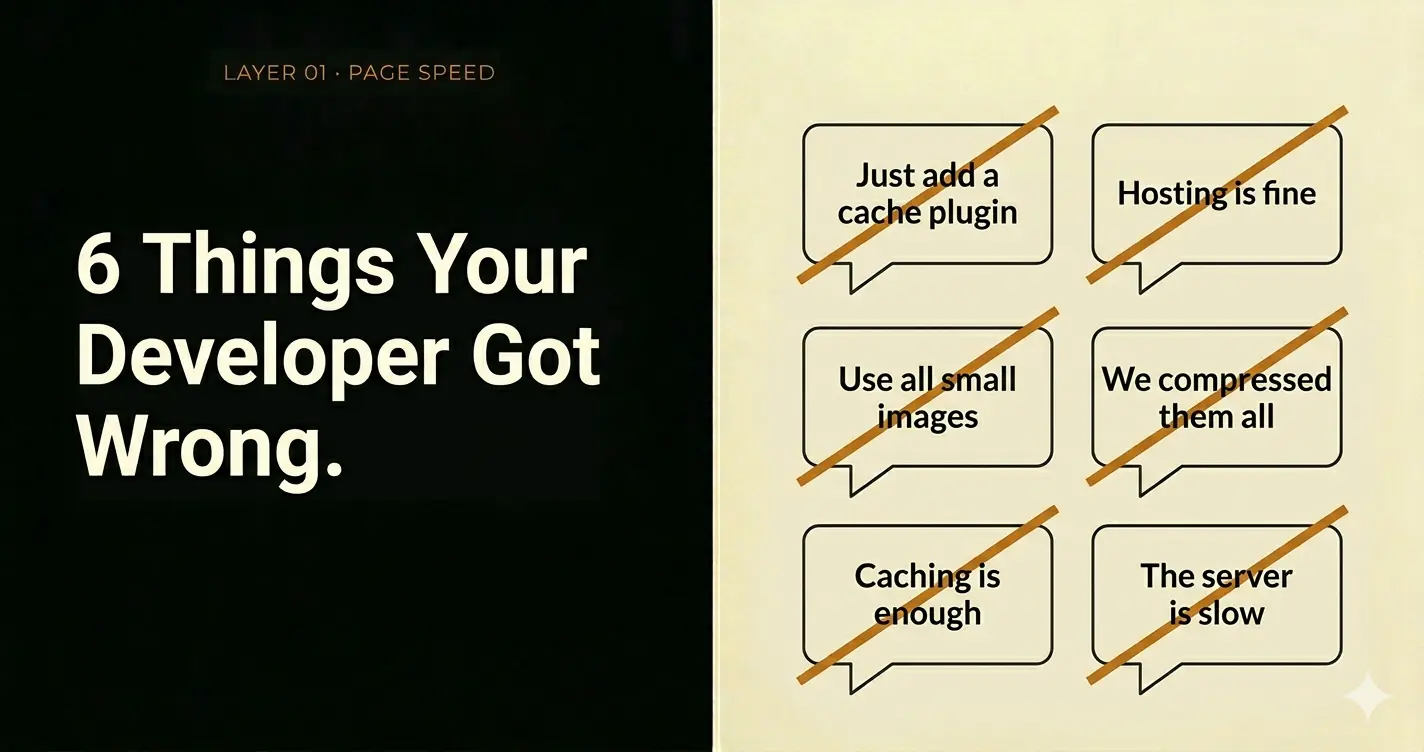
Most page speed advice sounds reasonable. Most of it is also incomplete. Business owners hear something from a developer or an agency, it sounds logical, and they move on — while the real problems stay exactly where they are.
Here are the six myths we hear most often, and what is actually true.
Myth 1: “it Only Takes 3 Seconds — That’s Fast Enough”
Three seconds feels fast when you’re sitting on a good Wi-Fi connection testing your own site. It is not fast by any measurable standard that matters.
Google’s threshold for a good user experience is under 2.5 seconds for Largest Contentful Paint (LCP). More importantly, research consistently shows that 40% of visitors abandon a page that takes more than 3 seconds to load. On mobile, that number is higher.
What to actually measure: Open PageSpeed Insights, enter your URL, and check the Mobile tab. That score — not what you feel when you load your own site — is what your visitors experience.
Myth 2: “page Speed Only Affects Seo”
This is the most damaging myth because it makes page speed feel optional if you’re not focused on rankings. It is not optional.
Speed affects every visitor before they read a single word of your copy. A slow site means your ad spend is wasted — people click, wait, leave. Your conversion rate drops. Your bounce rate climbs. None of that shows up in rankings — it shows up in revenue.
The real impact of slow speed: higher bounce rate, wasted ad budget, lower trust, lower conversion rate, and yes — lower rankings too.
Myth 3: “i Installed a Caching Plugin — It’s Sorted”
Caching reduces server response time. It does exactly one thing: serve a stored version of your page instead of building it fresh on every request. That’s valuable. It is also not enough on its own.
Caching does nothing for unoptimized images, render-blocking JavaScript, bloated CSS from a page builder, or an oversized database. Most sites with caching plugins still score below 50 on mobile PageSpeed.
What caching fixes: server response time.
What it doesn’t fix: everything else — and “everything else” is usually where the real weight is.
Myth 4: “better Hosting Will Fix It”
Hosting matters. A badly built site on good hosting is still a badly built site.
Page builders like Elementor and Divi generate hundreds of unnecessary DOM elements on every page. No server upgrade fixes that. Images uploaded at 4MB each will load slowly regardless of where they’re hosted. A theme loading 12 JavaScript files will block rendering on the fastest server available.
The rule: Fix the code first, then upgrade the hosting if you still need to. Doing it the other way wastes money without solving the problem.
Myth 5: “my Desktop Score Is Good — That’s What Matters”
Over 60% of web traffic globally is mobile. Google uses mobile-first indexing — meaning it crawls and ranks your site based on the mobile version, not desktop.
A desktop score of 90 with a mobile score of 28 is not a good result. It means the majority of your visitors are having a poor experience, and Google is evaluating you based on that poor experience.
The only score that matters first: mobile. Open PageSpeed Insights, check Mobile. Start there.
Myth 6: “we Fixed It Once — It’s Done”
Page speed degrades over time. Every new plugin adds weight. Every unoptimized image uploaded to the media library accumulates. Every theme update can introduce new scripts. Every new feature added to the site touches performance in some way.
A site that scored 85 at launch can score 40 eighteen months later with no deliberate changes — just the normal growth of a website that nobody is monitoring.
Fix: Check your PageSpeed score quarterly at minimum. Treat it the same way you’d treat any other business metric that matters — because it affects all of them.
Page speed is not a technical checkbox on a developer’s list. It is the first thing every visitor experiences about your business. If it’s wrong, nothing else — your copy, your design, your SEO, your ads — gets a fair chance to work.
Is your website making the same mistakes?
We manually assess every layer — backend to frontend — and show you exactly what is holding your site back. No tools, no guesswork. It is free.
Get Your Free Assessment →