
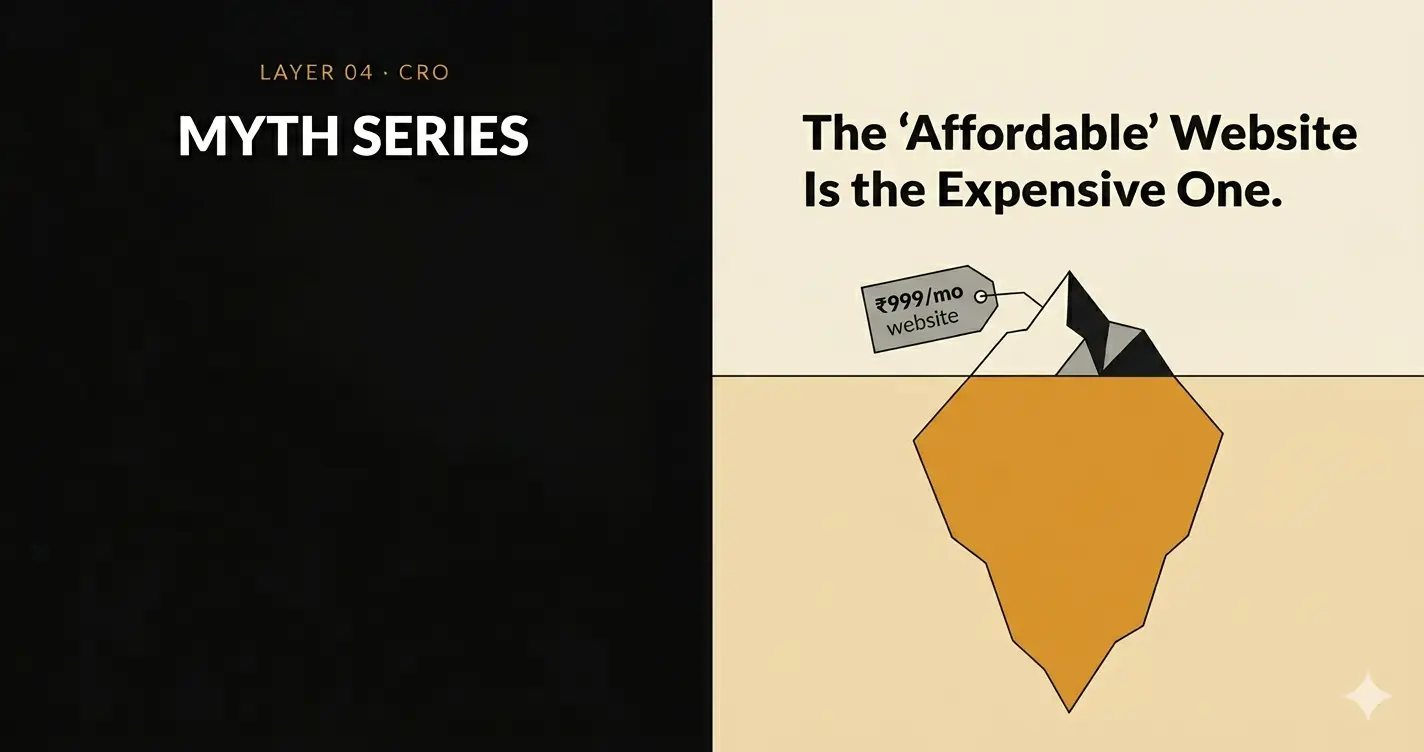
Keeping website costs down sounds like good business sense. And it can be — when the right things are prioritised. The problem is that most “affordable website” decisions are based on beliefs that feel reasonable but consistently produce expensive outcomes.
Here are the five we see most often.
Myth 1: “a Cheap Website Is Better Than No Website”
The idea here is that something is always better than nothing. For websites, that is not reliably true.
A slow, confusing, or untrustworthy website does not sit neutrally in front of potential clients — it actively damages their first impression of the business. A visitor who lands on a poorly built site and leaves does not think “they probably have a better site coming.” They simply do not trust the business.
What is actually true: A website that does not build trust or create a clear next step for the visitor is not an asset. For service businesses especially, a poor website costs more in lost leads than no website would have.
Myth 2: “we Can Always Upgrade It Later”
This is the most common plan that never happens. “Later” becomes maintaining the current site because the business has grown around it. Pages get added. Content gets published. Staff get used to the admin. The cost and disruption of changing everything increases every month it is left.
Beyond inertia, migration itself costs money. Moving content, redirecting URLs without destroying SEO, rebuilding functionality in a new system — a proper migration of an established site routinely costs more than building correctly from the start would have.
What is actually true: The cheapest time to build a site right is before launch. Every year that passes after that makes the right decision more expensive.
Myth 3: “a Premium Template Looks Professional Enough”
Premium templates look professional in the preview. In practice, they look like the template — because tens of thousands of other websites are using the same one with slight colour changes.
More importantly, a template is built around someone else’s content structure. Fitting a business’s actual messaging, services, and user journey into a template usually means either distorting the message or distorting the layout. Neither outcome serves the visitor.
What is actually true: Templates reduce build time. They do not reduce the work required to make a website actually perform for a specific business. That work has to happen regardless — in a template, it just happens inside a worse structure.
Myth 4: “free Plugins Do the Same Thing”
Free plugins often do the same thing — until they stop. Free plugins are maintained when the developer feels like it. They get abandoned when the developer moves on. They introduce security vulnerabilities when they go months without updates. And they add to a collection of dependencies on the site that interact with each other in ways nobody tracks.
The real cost of free plugins is not the licence fee saved. It is the debugging time when something breaks, the cleanup time when one is exploited, and the performance cost of running more of them than the site needs.
What is actually true: The question is not “free or paid.” It is “does this solve a real, specific problem, and is it actively maintained by a credible developer?” If the answer to both is yes, the cost is justified. If not — free or paid — it should not be on the site.
Myth 5: “the Price Difference Is Not Worth It for a Small Business”
This argument compares the upfront cost difference without comparing what each option actually returns. A cheap website that generates no leads has a worse ROI than a properly built website — regardless of the price gap between them.
For a service business where a single new client is worth hundreds or thousands, the calculation changes. If a properly built site generates two more enquiries per month than the cheap alternative, the price difference is recovered in the first client.
What is actually true: The right comparison is not “what does each option cost?” It is “what does each option return?” A website that costs twice as much and generates three times the leads is not the expensive option.
The pattern across all five myths is the same: a decision that reduces the immediate number creates a larger cost later — in lost leads, in rebuilds, in maintenance, in missed opportunities. The affordable website is rarely the one with the lowest upfront price.
Is your website making the same mistakes?
We manually assess every layer — backend to frontend — and show you exactly what is holding your site back. No tools, no guesswork. It is free.
Get Your Free Assessment →